
The Waste Land
a poem by T.S.Eliot

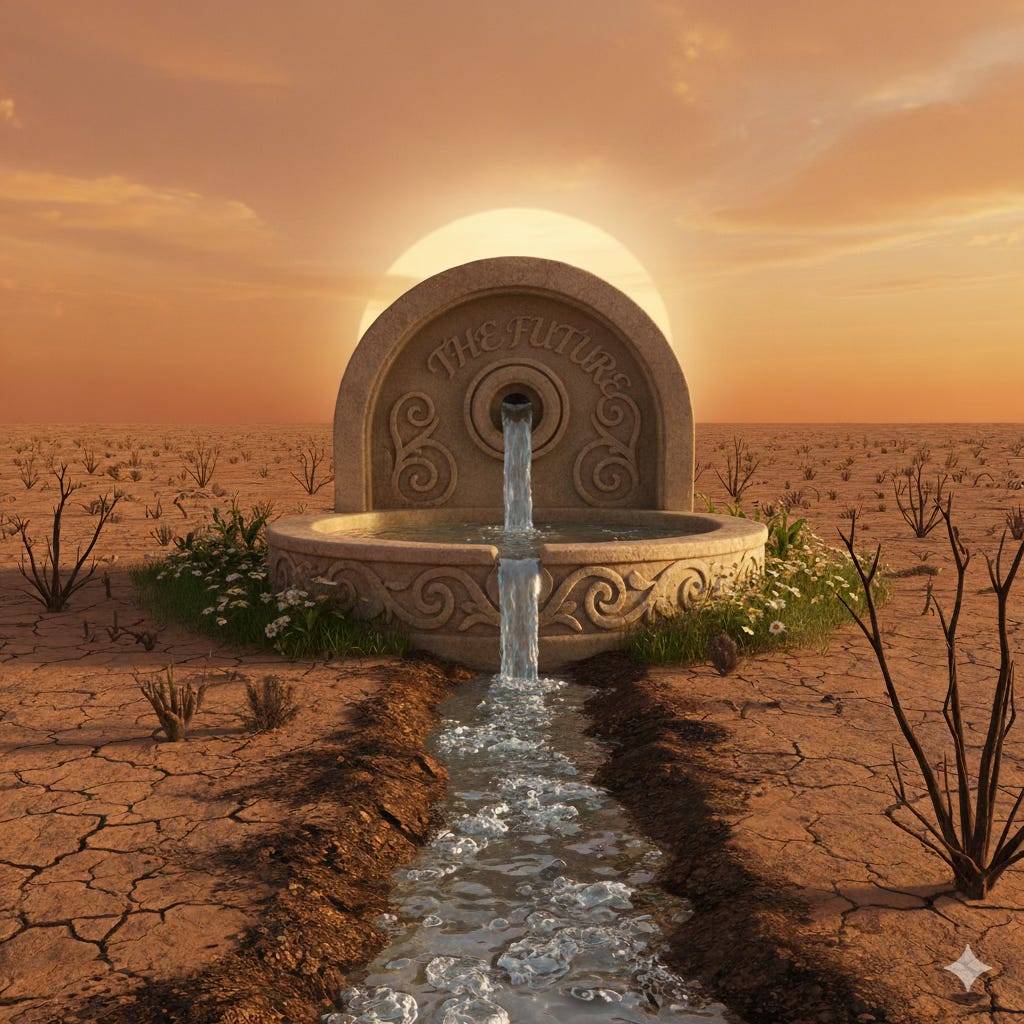
When a society suffers dislocations, does that portend the end of that society or does it simply designate a new beginning? When the social, religious, and metaphysical foundations of life are shattered, when the truth, or lack thereof, is laid bare does this constitute a tragedy or the necessary progression of the human soul?
The Waste Land, published in October of 1922, is a poem made famous because it is seen to be an incredibly innovative work situated at a significant crossroads in Western history. Written in the aftermath of The Great War as it was known in the twenties, it was at the very apex of the “modern” era where art was liberated from it’s foundations, where it didn’t have to make sense, where it began to belong to a small contingent of the initiated, incomprehensible to the great masses. The connective tissues, the expository explanations that would normally accompany a work (making it understandable to anyone willing to read it closely) were optional.
And so the poem, in a sense, doesn’t write or evoke the idea of a great Western wasteland so much as it embodies it. It is the not the content of the poem that matters so much as its construction. It’s here that art becomes art for art’s sake, a new and different form of mysticism detached from the reality of a god.
Eliot wrote his poem over a hundred years ago in response to a general feeling that society had undergone an irreversible disintegration, which was a very common belief amongst his cohort (a group known as The Lost Generation). The Great War had stripped away all meaning for them. Science and technology had created bewildering changes at a breakneck pace that upset everybody’s ordinary way of living. (Sound familiar?) The future didn’t make any sense. The effect was that the normal rhythms of life, the glue that a society could rely on had rotted away and left nothing but the illusion of continuity, of coherence. The world we now know sprung from this vacuum and we have been living in it ever since.
Today, it’s very hard for us to believe that people felt that way a hundred years ago. We look back and see a time where people still agreed on basic facts. They were, to us, happily entrenched in family life, religion, the workplace, etc. But what the poem’s existence tells us is that where we are now is something that’s been in the process of happening for at least the last one hundred years, that the world has been working it’s way toward this moment for some time. The Enlightenment beliefs in progress and in science, which has helped the Western world to ascend, looks more and more to us like a dystopia, a meaningless nightmare of consumption and various forms of political and social control. It’s a change that started slowly and picked up steam and has led to a point where almost every Western society can’t tell up from down, right from wrong, lies from the truth. And through it all there is this desperate belief, on all sides of the political spectrum, that everything is at stake, that the other side represents the destruction of the future, that we live in a zero sum game which is winner take all. But if in fact this process has been taking place for at least a hundred years, who is actually to blame? Who amongst us is the enemy?
The poem’s literary allusions run the gamut, from traditional Greek myth, to the Upanishads, to British musical revues, to references that are so deeply personal you couldn’t possibly understand what Eliot was after unless you knew the man. HIs methods presage the modern art movement.The way the poem abruptly shifts from one point of view to the other, from one storyline to the other, from one metaphor to the other is much like something you might to see in a Jean-Luc Goddard movie, such as Breathless or Weekend. The only real difference between these artists, in fact, is the sense of loss. Eliot clearly misses the loss of connective tissues and mourns it while Goddard makes a sport of it and finds nothing in it but hope and wicked glee.
The larger overall question, which the poem does not address, however, is, does this new way of living in the world, with its ever-growing absence of a traditional god, of collective social norms and connective tissue, constitute some kind of obscure progress towards a better way of life, or maybe even a new and more enduring form of mysticism? Or is it the end of the intellect, of civilization as we know it, and a return to what might have once been considered barbarism?
If Eliot’s choices in life are to tell you anything, he believed the world was in danger of moving toward the latter. Tradition he had decided was better than what the future was likely to bring. He shocked his progressive and atheistic friends by becoming Anglo-Catholic in 1927 and remained so for the rest of his life. He was, in small part, sympathetic to the blood and soil movement at the time, one which valued an homogenous ethnicity and cultural background and looked with suspicion on those people and things which might complicate it.If that sounds familiar that’s an attitude (or belief, if you want to call it that) which is prominent right now, in the virulent anti-immigrant stances you see in a lot of Western countries.
So what, then, should The Waste Land mean to us now? Is it a bold and esoteric announcement of our continuing decline? Or does it simply illustrate that history is cyclical and that every hundred years or so Western culture finds itself in a panic over the direction it seems to be in?
The theories on the life and death of civilizations espoused by historians such as Polybius, or John Bagot Glubb are certainly compelling and go in and out of fashion. It’s natural to believe that everything eventually undergoes disintegration and collapse. But the fact is history does not repeat itself and there’s nothing about cultural life and society that says decline is inevitable.There is no discernible law existing somewhere out there that demands it. What this means is that we are on our own. A wasteland is an idea, a value judgment, which can only be understood by its utility -- how useful it may be to help us get to where we want to go.This means that we will have to work together for the answers, some of which will have to be invented and some of which we can rely on from the past. It is not identity that matters, after all, but humanity. The Waste Land, through its beauty, its despair, its astonishing intellectual and artistic breadth, is still capable of giving us some kind of foothold from which we can still monitor ourselves, from which we can evolve.